You set your morning mug down without thinking. There’s no coaster or trivet, just ceramic on stone while you reach for the cream. That moment repeats hundreds of times a year, and it decides whether a countertop works with your life or against it. It’s also one of the first things Charlotte homeowners ask Waterfall Countertops when they compare premium stone surfaces: can I put a hot cup of coffee on quartz? The short answer is yes. The longer answer is worth knowing before you commit to custom countertops for the island you plan to stand at every morning for the next fifteen years.
That longer answer covers several things. A coffee mug and a hot skillet are very different problems for quartz. Marble’s weakness with coffee has nothing to do with temperature. A waterfall edge makes any mark more visible. And Charlotte’s summer humidity quietly favors one material over the other. Here is how each of those plays out in a real kitchen, along with how marble compares to granite and what marble actually costs.
Can I Put A Hot Cup Of Coffee On Quartz Without Damaging It?
Yes. A freshly poured cup of coffee is typically between 130 and 180°F by the time it touches your counter, and quartz can handle that contact without etching, cracking, or discoloring in many cases.
The reason comes down to what quartz is made of. Engineered quartz combines crushed natural quartz with a polymer resin binder. The quartz itself tolerates heat extremely well. The resin is the part that can react to heat, so it’s the part worth understanding. Quartz resin binders stay stable at temperatures above boiling water (212°F), and a mug of coffee never gets close to that once it leaves the pot. It also starts cooling the moment you pour.
The mug works in your favor too. Ceramic is a poor conductor of heat, and most mugs rest on a narrow foot ring rather than a flat base, so very little heat reaches the stone. The countertop is a dense, heavy slab that spreads that small amount of warmth across its mass. Picture a typical weekday: you pour a second cup, set it on the island, take a call in the next room, and come back forty minutes later to a lukewarm mug. On quartz, nothing marks the spot where it sat in one homeowner’s kitchen.
The same holds for iced coffee. Quartz does not absorb liquid, so the condensation that pools under a cold glass wipes away without leaving a water ring. If you want a striking island without rearranging every morning habit, that characteristic may be a deciding factor.
If Coffee Is Safe, What Actually Damages Quartz?
Hot cookware is what damages quartz. A skillet or pot moved straight from a burner can reach around 400°F, and setting it directly on the counter can cause localized resin expansion, scorch marks, and cracking, especially near seams.
Two things separate a skillet from a mug: the temperature difference and how long the contact lasts. A pan’s flat base presses its full surface against the stone, so heat moves quickly into one concentrated area. Cast iron and heavy stainless steel hold that heat for a long time. The resin in that spot expands faster than the cool stone around it, and the stress has to go somewhere. That’s why thermal damage on quartz is often traced back to cookware rather than beverages. Seams, sink cutouts, and edges are where cracks tend to start, since those are already the slab’s weaker points.
Independent testing supports the caution. Consumer countertop evaluations have flagged heat as a weaker point for engineered quartz than for natural stone, which is why trivets and hot pads belong next to any quartz range. The same logic applies to countertop appliances that run hot for hours, such as slow cookers or electric griddles. Short contact is rarely the issue, but sustained heat in one spot is.
Good kitchen design reduces the temptation. Planning guidance from the National Kitchen & Bath Association calls for landing space beside the cooktop, and that’s where a reliable trivet habit starts. During custom countertop design, we at Waterfall Countertops look at where hot pans will actually land in your layout so that a trivet or heat-safe board lives exactly where your hand reaches first.
Why Does Coffee Leave Rings On Marble When Quartz Shrugs It Off?
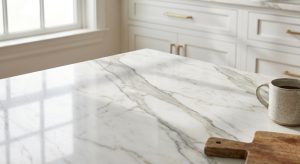
Marble’s risk with coffee is chemistry, not heat. Coffee is mildly acidic, and marble is made of calcium carbonate, so a drip that sits on the surface can etch a permanent dull ring even when the coffee is lukewarm.
Etching is different from staining, and the difference matters. A stain is something soaking into the stone. An etch is acid dissolving a microscopically thin layer of the polished surface, leaving a cloudy spot that looks like a water mark but won’t wipe away. The Natural Stone Institute notes that calcareous stones like marble react to acids, and that a sealer helps resist stains but does not stop etching. That’s why a freshly sealed marble island can still show coffee rings within weeks if spills are left to sit.
The ring usually forms under the mug itself. A single drip runs down the outside of the cup, collects at the base, and sits there through breakfast. Lemon juice, wine, tomato sauce, and vinegar-based cleaners do the same thing, but coffee is the one that touches the counter every day. Finish plays a role too, since etching shows sharply on polished marble and blends in more on a honed finish, which is already matte.
When Charlotte homeowners choose marble with us at Waterfall Countertops, our guidance is simple: wipe coffee spills immediately, and use coasters as an acid barrier rather than heat protection. If you’re still weighing whether marble’s veining and character fit your needs, our guide to marble countertops for Charlotte homes walks through varieties, finishes, and how each one wears.
Is Marble Good For Countertops?
Marble may be a good countertop choice for homeowners who value natural beauty and are comfortable with a bit of daily care. No engineered surface fully matches the depth of its veining, and in a waterfall design, a bookmatched marble slab can look like a single piece of stone folded over the edge of your island. It stays cool to the touch, which bakers appreciate, and it handles heat better than quartz does.
The trade-off is that marble is softer and more reactive than quartz or granite. It works in a kitchen where spills get wiped promptly, or in a home where you’d rather see the stone age naturally than stay pristine. It’s also a choice for bathroom vanity countertops, where acidic spills are rare and the veining gets to shine without much risk. If your kitchen is a busy, high-traffic space with lots of coffee, citrus, and wine, marble can still work, but it helps to go in with clear expectations.
What Is The Downside Of Marble Countertops?
Marble’s drawbacks are real but manageable once you know them. The main ones are:
- Etching from acids: Coffee, citrus, wine, tomato, and vinegar can leave dull marks that sealing does not prevent.
- Staining if unsealed: Marble is porous, so oils and dark liquids can soak in without regular resealing.
- Scratching: It’s softer than granite and quartz, so knives and gritty pans can leave marks.
- Ongoing maintenance: Periodic resealing and pH-neutral cleaners are part of owning it.
- Humidity sensitivity in Charlotte summers: Condensation from cold drinks makes water rings and etching more likely.
- Cost: Premium marble varieties often cost more than many granite and quartz options, especially for waterfall fabrication.
- Visible marks on a waterfall edge: Any etch near the mitered corner sits right in the sightline.
Some marble owners decide these are worth it for the look. Others realize their routine fits quartz or granite better, which is exactly why comparing materials side by side helps.
Which Countertop Is Better, Granite Or Marble?
Granite may be a better choice for durability and low maintenance, while marble may be a better choice if a soft, classic veined look matters most. Both are natural stone, but granite is harder, less porous, and far less reactive to acids, so it holds up to busy kitchens with less maintenance.
| Factor | Granite | Marble |
|---|---|---|
| Hardness and scratch resistance | Very hard, resists scratches | Softer, scratches more easily |
| Reaction to coffee and acids | Rarely etches | Etches readily |
| Heat tolerance | Excellent | Good, but a trivet is still wise |
| Stain resistance | Good when sealed | Fair, needs regular resealing |
| Look | Speckled or flowing patterns, bold colors | Soft, elegant veining |
| Maintenance | Low to moderate | Moderate to high |
| Waterfall edge appeal | Striking with bold movement | Stunning when bookmatched |
| Typical installed cost | Often lower to mid-range | Often mid to high range |
If you love veining but want granite’s toughness, certain granites have soft, marble-like movement. We at Waterfall Countertops can show you those slabs during stone material selection.
How Waterfall Edge Designs Raise The Stakes For Surface Care
A waterfall edge makes every mark more visible. The stone’s pattern runs continuously from the countertop down the vertical side, and the eye follows that line, so a scorch mark or etch ring near the edge interrupts the exact feature you’re paying for.
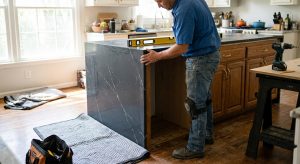
Waterfall edge countertops are our specialization at Waterfall Countertops, and because we handle custom design, fabrication, and installation ourselves, we control how the stone’s pattern wraps from the horizontal surface to the vertical one through a mitered corner. Done well, the veining appears to flow over the edge like a single folded piece of stone. You may be concerned about whether the seams and veining will line up cleanly, and that’s a fair concern, because the miter is where craftsmanship shows. It’s also why surface care matters more on a waterfall island. A dull etch on a standard eased edge disappears among everyday clutter, but the same etch on top of a waterfall corner sits right in the sightline of anyone walking into the room.
That corner is also the busiest spot on the island. It’s where people lean, where mugs land on the way to the table, and where a pan sometimes gets set down when someone is in a hurry. On quartz, the concern is heat near the mitered seam, which is one more reason to keep trivets close. On marble, the concern is drips, since coffee that spills at the edge can run down the vertical face and etch a streak along the waterfall panel. That kind of mark is harder to restore invisibly than a spot on a flat surface.
None of this means a waterfall edge is fragile. It means the material you choose should match how you’ll treat that corner. During material selection, we at Waterfall Countertops can show you how quartz with consistent veining and marble with dramatic bookmatching each behave at the miter, so you choose with your routine in view.
Should Your Charlotte Kitchen Get Quartz Or Marble?
If you want to set your coffee down anywhere without a second thought, quartz may fit your routine better. If you love natural veining and are comfortable with a coaster habit or a gradual patina, marble can be a choice to consider, though Charlotte’s humid summers may tip the scale slightly toward quartz for heavy daily use.
Humidity matters more than some buyers expect. The U.S. Environmental Protection Agency recommends keeping indoor relative humidity below 60 percent, ideally between 30 and 50 percent, and Charlotte summers push many homes toward the upper end of that range. We at Waterfall Countertops factor local climate into every material recommendation, including how condensation from cold drinks and steam from hot beverages interact with marble’s calcium carbonate surface. A glass of iced coffee or sweet tea sweats faster in July, and on marble that pooled moisture leaves water rings and makes etching show more readily. Quartz is unaffected either way.
Think about who uses your counters. A morning rush in a Fort Mill or Pineville household might mean three people pouring coffee, packing lunches, and leaving mugs on the island before the commute. A quieter home in Belmont or Mt Holly might have one careful coffee drinker who wipes every drip. Both households can find a stone that fits. Here’s how quartz and marble compare across a typical day:
| Daily situation | Quartz | Marble |
|---|---|---|
| Hot mug (130 to 180°F) set down | Safe in most cases, no mark | Safe from the heat itself |
| Coffee drip left under the cup | Wipes clean | Can etch a permanent dull ring |
| Iced drink condensation in summer | No ring | Water rings more likely in humid months |
| Hot skillet straight from the stove | Use a trivet; resin can scorch or crack | More heat tolerant, but a trivet is still wise |
| Sealing | Not required | Periodic resealing for stain resistance |
| Coasters | Optional | Recommended as an acid barrier |
| Appearance after years of use | Stays uniform in some kitchens | Develops a softer patina of faint rings |
Neither column is the wrong answer. The real question is which one describes the kitchen you actually live in.
How Much Do Marble Countertops Cost?
Marble countertops typically run about $75 to $200 per square foot installed, depending on the variety, slab thickness, finish, and edge work. A waterfall island usually lands at the higher end because the stone continues down one or both sides and requires precise mitering and vein matching.
Several factors move the number. Common white marbles sit toward the lower end of that range, while rare, dramatically veined varieties climb quickly. Thicker slabs, honed or specialty finishes, sink and cooktop cutouts, and the extra stone a waterfall panel requires all add to the total. Bookmatching, where two slabs are mirrored so the veining flows across a seam, takes more material and more fabrication time, but it’s often what makes a waterfall island look seamless.
If you’re concerned about a quote that balloons later, that’s understandable. Ask for a written quote that itemizes the slab, fabrication, edge work, cutouts, and installation so you can see exactly where the money goes. If marble stretches your budget, quartz and granite can deliver a waterfall impact at different price points, and comparing all three side by side is one way to see what each difference is worth to you.
What Daily Habits Keep Either Surface Looking Its Best?
On quartz, the main habit is keeping hot cookware on a trivet. On marble, the habits are wiping coffee right away, using coasters, and resealing on a schedule, or deciding up front that a soft patina is part of the stone’s appeal.
With quartz, you can set mugs down freely. Daily cleaning is warm water and mild dish soap on a soft cloth. Skip abrasive scrub pads and harsh chemicals like oven cleaner, which can dull the resin over time. Keep a trivet beside the range and a cutting board near the prep zone, and quartz asks very little else of you.
Maintaining and cleaning marble comes down to a short routine built around your coffee:
- Set mugs on a coaster or a small tray at your coffee station.
- Wipe any drip or spill within a minute or two using a damp soft cloth.
- Dry the spot so condensation doesn’t sit, especially in summer.
- Clean with a pH-neutral stone cleaner, never vinegar or citrus-based sprays.
- Reseal on the schedule your fabricator recommends, and check by watching whether water still beads on the surface.
Some marble owners follow that routine faithfully and keep a near-showroom finish. Others relax and let the surface develop a patina of faint rings, the lived-in look of an older, well-loved kitchen. Many homeowners make the final call based on one honest question: do you want to adjust your daily habits, or choose a surface that adjusts to you? Answering that clearly before you buy matters more than any spec sheet.
What Else Do Homeowners Ask About Coffee And Countertops?
Most follow-up questions come down to temperature, coasters, and climate, and each has a short answer.
Can I put a hot cup of coffee on quartz every day?
Yes, in most cases. Daily contact with a hot mug is unlikely to harm quartz, because coffee stays far below the temperatures that affect the resin.
Will a hot coffee mug crack quartz countertops?
In most cases, no. Coffee mugs reach roughly 130 to 180°F, well below the temperature that damages quartz, and ceramic transfers very little heat to the stone.
What temperature will damage quartz countertops?
Sustained contact above about 300°F, usually from cookware taken straight off a burner, can cause localized resin expansion and cracking. Brief contact with a warm dish is very different from a 400°F skillet left in place.
Do I need coasters on quartz countertops?
Not for heat. Quartz resists thermal damage from mugs and glasses and doesn’t absorb condensation, so cold drinks won’t leave rings either in most scenarios.
Can you put hot coffee on marble countertops?
The temperature is safe, but coffee’s acidity etches marble and can leave permanent dull rings. Wiping drips immediately and using coasters prevents most of them.
How does Charlotte humidity affect quartz versus marble countertops?
Quartz is unaffected. Marble shows etching and water rings more readily in humid months, as condensation and steam interact with its calcium carbonate surface.
See Both Surfaces Before You Decide
One reliable way to settle quartz versus marble (or granite) is to see the slabs up close with a team that specializes in waterfall edge countertops. Call Waterfall Countertops at (704) 780-3235 to schedule a stone material selection consultation. We serve Charlotte, Belmont, Mt Holly, Fort Mill, and Pineville, and we’ll help you compare quartz, granite, and marble side by side to find the premium stone surface that fits both your routine and your budget.
Before that conversation, spend one morning noticing exactly where you set your mug down, how long it sits, and whether anyone wipes the counter afterward. So, can I put a hot cup of coffee on quartz without concern in most cases? Yes, and if that mug spot turns out to be the corner of your future waterfall island, bring that detail with you. It tells us at Waterfall Countertops more about which stone may still look right in ten years than any photo you’ve saved.
- Individual results with countertop materials vary based on daily use, maintenance habits, local climate, and specific product formulations.
- Pricing ranges in this article are general estimates for planning purposes only and are not a quote.
- Actual costs vary by material, slab selection, layout, and project scope.
- Care guidance is general; always follow the specific recommendations for your stone and sealer.
Your Quartz Deserves the Right Care
If you’re wondering whether your morning routine might be damaging your countertops, you’re already thinking like someone who values their investment. The team at Waterfall Countertops has helped countless Charlotte homeowners understand exactly how to protect and enjoy their quartz surfaces for years to come. Whether you’re considering quartz for a new kitchen or want guidance on caring for what you already have, a quick conversation can give you the clarity you need.