
You’ve seen white marble countertops in luxury home tours, design magazines, and high-end kitchen showrooms, and you know the appeal: veining that catches light differently than any engineered surface and a cool touch that feels substantial under your hand. Then someone mentions etching from lemon juice, and suddenly you’re second-guessing the entire material. At Waterfall Countertops in Charlotte, we walk homeowners through this exact decision as part of our stone material selection process, because white marble isn’t a material you choose casually. You choose it deliberately, knowing exactly what you’re gaining and what you’re committing to maintain.
This guide covers six things you need to decide well:
- The three white marbles most homeowners compare
- How Charlotte’s climate changes the care routine
- Where marble belongs in a home and where it struggles
- What a waterfall edge adds
- What you should realistically budget
- How the stone ages over time
If you’d like a broader look at the stone first, start with our overview of marble countertops for kitchens and baths.
Carrara, Calacatta, or Statuario: which white marble fits your project?
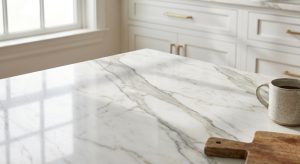
Carrara is the value choice, Calacatta is the statement choice, and Statuario is the gallery choice. All three come from the same mountain region of northern Italy, but they differ in background tone, vein character, scarcity, and price. Those differences matter more than most inspiration photos reveal.
Carrara
– Look: a soft white to light gray background with fine, feathery gray veining spread across the slab. From across a room, it reads as a calm, slightly cool white.
– Availability and price: it’s the most widely available of the three and sits in the most approachable price tier.
– Best fit: a common pick for bathroom vanity countertops, perimeter runs, and homeowners who want genuine marble without paying for drama. Its busy, subtle pattern may also make small etches less noticeable, blending more readily into the veining pattern in some installations.
Calacatta
– Look: a brighter, whiter background with thicker, bolder veins that can run gray, taupe, or gold. The veining sweeps rather than scatters, so two slabs can look completely different.
– Availability and price: it’s rarer and priced in a higher tier.
– Best fit: it’s the marble most people picture when they say “statement island,” and it’s the one homeowners most often ask us to run down the side of an island as a waterfall edge.
Statuario
– Look: a bright white background with crisp, graphic gray veining, often sparser than Carrara’s.
– Availability and price: top-quality Statuario is scarce and usually lands in the top price tier alongside the best Calacatta.
If you’re choosing countertops for the first time, you don’t have to sort this out alone. During a custom countertop design consultation at Waterfall Countertops, we start with how you want the room to feel and where the stone will sit, and then we narrow the choice to a marble type and finish that fit your budget. Finish deserves real attention:
- Polished: makes veining pop and resists stains slightly better, but etch marks show as dull spots.
- Honed: a soft matte finish that may help hide etching somewhat. It can absorb stains more readily, so it depends more heavily on good sealing.
Charlotte humidity changes how often your white marble countertops need sealing
Once you’ve settled on a look, the next question is upkeep, and here Charlotte’s climate plays a real role. Plan to test and reseal white marble every 6 to 12 months rather than assuming a once-a-year or longer schedule will hold. Charlotte’s humid subtropical climate keeps surfaces damp for more of the year, and marble is porous enough that moisture, along with whatever it carries, can work into unprotected stone.
Humidity alone won’t stain marble. The real issue is how much water a countertop in Charlotte, Fort Mill, or Pineville sees in a year:
- Summer drinks: iced drinks leave sweating glasses on the island, and those leave rings on poorly sealed stone.
- Steamy bathrooms: long hot showers keep vanity tops wet longer.
- Frequent cleaning: humid-season kitchens get wiped down more often, and every pass with a cleaner wears at the sealer a little.
Together, these mean the protective layer that might last longer in a drier climate tends to fade sooner here.
A better approach doesn’t rely on a calendar:
- Drip a little water on several spots, especially near the sink and coffee station.
- Wait about 15 minutes.
- Check the color. If the stone darkens where the water sat, the sealer is thin there and it’s time to reseal. If the water beads and the marble stays the same color, you’re still protected.
Running this test every few months tells you more than any rule of thumb. Two everyday habits matter even more in a humid climate: use coasters under cold drinks, not just hot ones, and wipe up standing water around faucets instead of letting it air dry.
Where does white marble belong in your home, and where does it struggle?
Care routines only go so far, so placement matters just as much. White marble performs differently in bathrooms and in low-prep kitchen zones like bar tops, beverage stations, and islands used more for gathering than chopping. It’s most demanding on the main prep counter beside the stove and sink, where lemon, tomato, vinegar, and wine land daily.
The reason is chemistry. Marble is mostly calcite, a form of calcium carbonate, and acids react with it on contact. That reaction, called etching, leaves a dull, slightly rough mark. Sealer slows absorption, which helps with stains, but it can’t stop acid from touching the surface. On a primary prep counter, etching can appear within months unless you wipe spills immediately. Some homeowners make peace with that, while others find it frustrating.
Bathrooms are easier. Vanity tops see soap, toothpaste, and water, with far fewer acids than a kitchen. The main risks are cosmetic products: perfume, hair dye, some skincare, and mouthwash can etch or stain. A tray for bottles addresses much of the concern, which makes a marble vanity one installation option where daily care demands may be lighter.
In kitchens, be honest about how you cook.
- If you cook heavily (citrus, sauces, and fresh produce most nights), consider a split design: a marble island for serving and entertaining, paired with quartz or granite on the perimeter prep run.
- If you cook lightly or reliably use cutting boards, marble may work throughout the kitchen, though etching and staining remain possible in any installation.
Because Waterfall Countertops fabricates and installs quartz, granite, and marble, we can place each of these stone surfaces where its properties fit the intended use instead of pushing one stone onto every surface.
Will the veining line up on a white marble waterfall edge?
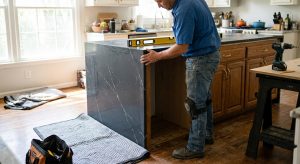
It can, but only when the slab is chosen and laid out for the waterfall before a single cut is made. A waterfall edge carries the countertop down the side of the island to the floor. On white marble, the goal is for the veins to cross that corner as if the stone simply folded.
That’s why white marble and waterfall edges pair so well. Marble’s veining is the whole show, and a waterfall gives it a vertical stage. Instead of a flat surface with a trimmed edge, you get an island that reads like a single sculpted block. In an open-plan Charlotte kitchen, it’s often the first thing a guest sees.
It’s also where the risk lives, and it’s fair to worry about it. The most common concern is that the corner will look like two unrelated pieces pushed together. Reducing that risk comes down to three decisions:
- Matched stone: the top and side panels come from the same slab or consecutive slabs, so the veining can continue.
- A mitered corner: the corner is typically cut at 45 degrees, so the joint sits right at the edge where it’s less visible.
- Layout on the actual slab: we plan the layout on the real slab, choosing where the strongest veins will cross the corner before fabrication starts.
Waterfall edge countertops are the specialty our company is named for, not an add-on, and because we handle design, fabrication, and installation ourselves, the same team that plans your vein layout is the one that cuts the miter and sets the panels.
Still, be realistic about what a waterfall involves:
- More stone: it often needs an additional slab.
- More precise work: mitered fabrication and careful handling during installation take time.
- Higher cost: expect a higher price than a standard island top.
- Layout difficulty varies: bold Calacatta or Statuario veining demands more careful layout than busier Carrara.
How much do white marble countertops cost in Charlotte?
A realistic planning range for installed white marble in the Charlotte area is about $75 to $250 per square foot, with Carrara toward the lower end and premium Calacatta or Statuario, especially with waterfall edges, toward the top.
You may be worried the number will grow after you’ve committed. That concern is reasonable, and the best protection is understanding what drives a quote:
- Material grade: the biggest variable. Carrara and top-grade Calacatta can differ dramatically for the same square footage.
- Slab count and size: a waterfall island or a long run without seams may require extra slabs, and you pay for the slab, not just the square footage installed.
- Edge profile and fabrication: mitered waterfall edges, sink and cooktop cutouts, and full-height backsplashes all add labor.
- Your project specifics: access, stairs, and whether existing countertops need removal can affect the final figure.
A simple example shows why the range is so wide. A 40-square-foot kitchen at $90 per square foot comes to $3,600, while the same kitchen at $200 per square foot comes to $8,000. Add a waterfall panel and the gap widens again.
When you compare quotes, ask that each one name the specific marble, slab count, edge treatment, cutouts, and installation scope. A clear, line-by-line quote tied to accurate measurements helps keep a budget from drifting.
How do you maintain and clean white marble so it stays in good condition?
Clean white marble daily with warm water and a pH-neutral stone cleaner, wipe acidic spills right away, and reseal whenever the water test shows absorption. Even with careful care, marble develops a patina, and deciding whether you’ll enjoy that is an important part of choosing it.
Follow this routine:
- Clean daily. Wipe with a soft cloth, warm water, and a pH-neutral stone cleaner or a few drops of mild dish soap, then dry the surface.
- Blot spills immediately. Lift acidic spills like wine, juice, and coffee by blotting, not rubbing.
- Skip harsh cleaners. Avoid vinegar, lemon-based products, bleach, ammonia, and abrasive pads. Use all-purpose sprays only if they’re labeled safe for marble.
- Draw out stains with a poultice. Use a baking soda paste for oil stains or a stone-safe peroxide poultice for coffee and tea on light marble. Cover it with plastic, leave it for 24 to 48 hours, then rinse.
- Protect from heat and knives. Marble tolerates warm cookware, though sudden high heat can stress the stone and damage the sealer, so use trivets. Always cut on a board, since knives can scratch the surface.
- Test and reseal. Run the water test every few months. When it’s time, apply a penetrating sealer made for marble and wipe off the excess as the label directs.
- Address light etching. Use a marble polishing compound on polished finishes, or call a stone professional for deeper marks.
If hygiene is on your mind, the Natural Stone Institute has published a study of the cleanability of marble and granite worth reading.
What patina means for you. Patina is the soft wear that builds up from years of use: faint etches, a gentler sheen, the marks of a kitchen people actually live in. It divides homeowners into two camps. Some appreciate that lived-in character, while others expect showroom perfection indefinitely and feel let down by the first etch. Waterfall Countertops tells clients during material selection that marble will change with use, because knowing which camp you’re in matters more than any sealer you buy.
The hard questions to settle before you commit to white marble
With cost and care covered, most remaining marble decisions come down to four questions: what can go wrong, whether marble suits countertops at all, and how it compares with granite and with quartz. Here are straight answers.
What is the downside of marble countertops?
- Etching: acids like citrus, vinegar, wine, and tomato leave dull marks on contact.
- Staining: white marble is porous, so pigmented spills show if the sealer is worn.
- Sealing commitment: in Charlotte’s humidity, test and reseal every 6 to 12 months.
- Scratches and chips: marble is softer than granite and quartz.
- Heat cautions: it handles warmth, but trivets prevent thermal stress and sealer damage.
- Cost: premium varieties and waterfall edges carry a real price.
- Slab variation: no two slabs match, so choose yours in person.
Is marble good for countertops?
Marble can work for countertops when your lifestyle matches its characteristics. Marble is one option for bathroom vanities, islands, bar tops, and baking stations, where its cool, smooth surface and veining can stand out and acids are rare. In a heavy-cooking kitchen, it may suit homeowners who accept etching as patina or who use cutting boards and wipe spills promptly. It may disappoint people who expect zero maintenance, which means the stone isn’t necessarily the problem; a mismatch with expectations is.
Which countertop fits better, granite or marble?
| Factor | Granite | Marble |
|---|---|---|
| Hardness | Harder, resists scratches and chips | Softer, scratches and chips more easily |
| Acid exposure | Resists etching from most kitchen acids | Etches on contact with acids |
| Staining | Lower porosity in most varieties | More porous, stains show on white stone |
| Heat | Handles hot cookware; trivets advised | Tolerates heat; trivets advised |
| Appearance | Speckled, granular patterns | Soft, flowing veining on bright backgrounds |
| Maintenance | Periodic sealing, low daily fuss | Regular sealing, prompt spill cleanup |
| Best fit | Busy prep kitchens | Baths, islands, bar tops, light-cooking kitchens |
Granite tends toward greater durability, while marble offers elegance and veining.
Which countertop fits better, quartz or marble?
| Factor | Quartz | Marble |
|---|---|---|
| Composition | Engineered from crushed quartz and resin | Natural metamorphic stone |
| Sealing | None needed | Regular sealing |
| Etching and stains | Resists both | Etches; stains if unsealed |
| Heat | Resin can scorch or discolor; always use trivets | More heat tolerant; trivets still advisable |
| Appearance | Consistent; marble-look patterns can repeat | Unique veining with natural depth |
| Aging | Stays largely the same | Develops patina |
Quartz offers lower maintenance demands, while marble offers authenticity.
Choose your marble from the slab, not a sample chip
The surest way to know whether white marble fits your home is to see full slabs in person and talk through exactly where the stone will go. A two-inch chip can’t show you how Calacatta veining will travel across a waterfall corner or how Carrara reads under your kitchen lighting.
Schedule a material selection consultation with Waterfall Countertops in Charlotte, NC 28273, by calling (704) 780-3235. During your visit, you can:
- See white marble slab options in person
- Talk through waterfall edge designs
- Decide whether marble fits your kitchen or bathroom remodel
Waterfall Countertops designs, fabricates, and installs custom countertops for homeowners across Charlotte, Belmont, Mt Holly, Fort Mill, and Pineville.
One thing to try before you decide: get an offcut of the marble you’re considering, put a drop of lemon juice, a splash of coffee, and a little red wine on it, and leave it overnight. If you can look at the result in the morning and still find the stone appealing, you may be ready for marble. If not, you’ve just saved yourself years of frustration, and a quartz or granite design may suit you better.
Safety note on fabrication: OSHA and NIOSH have warned that cutting and finishing stone countertops, particularly high-silica engineered stone, can expose workers to respirable crystalline silica. Researchers continue to document silica hazards in engineered stone production.
Ready to Explore White Marble for Your Charlotte Home?
If you’ve been wondering whether white marble is the right choice for your kitchen or bath, we’d love to walk you through your options in person. At Waterfall Countertops, we help Charlotte homeowners weigh the beauty of marble against their daily routines, so you can make a decision that feels right for years to come. Let’s talk about what would work best in your space.