Understand the cost of waterfall countertop per square foot
If you have ever envisioned a sleek, continuous slab of stone cascading down from your kitchen island or bathroom vanity, you have likely encountered waterfall countertops. But before diving into this premium look, it is natural to wonder about the cost of waterfall countertop per square foot. Generally speaking, you can expect to pay between $40 and $100 and beyond per square foot for high-quality stone slabs, such as quartz or granite, and potentially up to $100 per square foot for installation (Palm Beach Premier Remodeling). While this arrangement might sound significant, focusing on both short-term and long-term benefits can help you decide if this investment suits your preferences, needs, and budget.
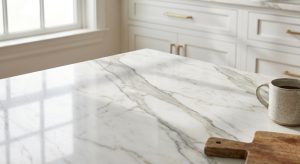
Waterfall countertops have long captivated interior design enthusiasts because of their modern elegance and practicality. These styles wrap around the side of the cabinet, creating a vertical slab that is aesthetically appealing and protective for your kitchen or bathroom surfaces. Below, you will learn how specific materials, fabrication methods, and installation choices can affect the total cost, as well as ways to approach budgeting more confidently.
Explore standard costs
When you begin to explore waterfall countertops, one of the first factors to address is the baseline cost of the slab itself. Stone options, including quartz, granite, marble, and quartzite, typically range from $40 to $100 per square foot, depending on quality, design, and brand (CaesarstoneUS). That covers only the raw material and does not factor in installation or other potential expenses. If your space requires an extensive number of square feet, or if you are drawn to rarer stone patterns, your expenses may rise accordingly.
- Stone slab cost
- Quartz: $40-$100 per square foot
- Granite: $40-$100 per square foot
- Marble: $50-$150 per square foot (depending on rarity)
- Quartzite: $60-$120 per square foot
- Installation fees
- Typically up to $100 per square foot
- Additional labor for waterfall edges and complex cuts
- CNC fabrication costs of up to $2,000 for precision cutting
- Ongoing maintenance
- Some materials, such as granite or marble, can require resealing
- Annual resealing costs can range from $200 to $1,200, factoring in the size of the surface (CaesarstoneUS)
By balancing the base material price with your desired kitchen layout, you will begin to form a realistic picture of your potential total cost. Although quartz may have similar upfront prices to other stones, many homeowners discover that it often requires less maintenance in the long run. On the other hand, if you adore the natural veining and classic elegance of marble, you might have higher ongoing care costs that factor into your total budget.
Compare popular materials
Choosing your stone is a personal and stylistic move, and it significantly impacts both your budget and your countertop’s daily performance. Each type of stone offers unique benefits, from durability to color consistency. To help you make a clear comparison, consider the following:
Quartz
Quartz stands out for its versatility. It comes in a variety of patterns and colors, including options that mimic marble or other natural stones. It is also prized because it usually requires little to no sealing. In terms of price, a quartz waterfall countertop can cost from $40 to $100 per square foot for the slab alone, with installation potentially matching or exceeding that amount. While the upfront investment can be steep, quartz surfaces are more resilient and do not typically require resealing, saving you time and money in the years ahead (Palm Beach Premier Remodeling). If you want more insight into why quartz is so popular beyond cost, check out waterfall countertop quartz durability.
Granite
Known for its extraordinary resistance to heat and scratches, granite is favored by those who do a lot of cooking or entertaining. You will find granite in a similar cost bracket to quartz, typically $40 to $100 per square foot, but the stone’s natural variation can make certain slabs more expensive. Additionally, granite may require routine resealing to preserve its immaculate look, which could range from $200 to $1,200 or more each year for larger areas (CaesarstoneUS). If you want specific insights into granite’s low-porosity versions, consider exploring granite waterfall stain resistance.
Marble
Widely considered the epitome of luxury, marble boasts exquisite veining patterns and a classic glow. This elegance comes with a price-alpha factor. Marble slabs can range from $50 to $150 per square foot, depending on quality or rarity, and they usually need regular sealing to protect against staining (Palm Beach Premier Remodeling). Costs can mount if you select a high-end piece for a full waterfall installation. Before committing, it can be helpful to weigh marble’s high-end perks against its extra upkeep by reading waterfall countertop marble elegance.
Quartzite
A natural stone with marble-like veining and the durability of granite, quartzite can command higher price points. Expect to pay around $60 to $120 per square foot. Like granite, quartzite usually requires sealing, but the frequency depends on how porous a particular variety is. If you are curious about how quartzite performs in a busy kitchen, quartzite waterfall durability benefits might give you further clarity.
Selecting the best stone for your waterfall countertop involves more than just cost. Think about how much effort you are comfortable investing in upkeep, as well as the visual style you want to achieve. If you prefer an easy-care option, quartz might be best. If you prefer that timeless elegance, marble or quartzite could capture your heart.
Account for installation fees
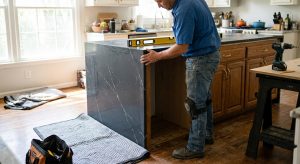
A waterfall design is more complex than a standard countertop in several ways. Beyond the horizontal surface, the slab must be carefully mitered and drop down vertically along one or both sides of a kitchen island or cabinet. This process requires:
- Precision measuring for exact dimensions
- Detailed miter cuts to achieve seamless corner edges
- Additional labor because installers handle multiple slab faces
Because of this complexity, fees can run as high as $100 per square foot for the installation alone (Palm Beach Premier Remodeling). You might also see a further $2,000 added to your bill for specialized cutting using CNC or laser-guided technology (CaesarstoneUS). This technology helps align patterns (especially for veined stones) and ensures that your waterfall edge has a smooth, cohesive appearance.
Ensuring perfect seams
Professional installers rely on custom measurements and advanced cutting tools to ensure near-flawless edges. Achieving that crisp, unbroken flow of pattern from countertop to side panel is essential for the elegant look of a waterfall design. In the case of stones with prominent veining, alignment must be nearly perfect to keep the flow visually continuous. If you plan to do a side panel on just one side of your island, installation labor costs might be a bit lower. However, for a full double waterfall that frames your island on both sides, you can expect more extensive measuring and cutting fees.
If you are considering whether to tackle the job yourself, read waterfall countertop diy considerations to understand common challenges. While DIY might save some money, the risk of improper cuts, visible seams, or safety issues can lead you back toward the value of professional experience. You can further explore the tradeoffs of having a specialist do the installation at waterfall countertop professional installation.
Analyze long-term upkeep
Even the most durable stones benefit from proper care. Quartz surfaces typically require only gentle wiping and an occasional non-abrasive cleaner, so they are relatively cost-effective to maintain. Granite, marble, and quartzite might involve periodic resealing to keep out moisture and staining. These ongoing maintenance costs, often ranging from $200 to $1,200 per year, tend to increase with larger countertop areas (CaesarstoneUS).
Frequency of resealing
- Granite: About once a year, though some varieties can go up to two years
- Marble: Often once or twice a year for heavily used surfaces
- Quartzite: Depends on porosity, usually once a year
- Quartz: Sealing typically not required
The long-term costs, such as resealing, should factor into your initial budget as you decide which stone and which layout are best. The more you take care of your countertop, the more it rewards you by maintaining that flawless, cascading appearance.
For a deeper look on how to preserve your countertop’s pristine surface, consider reading waterfall countertop maintenance tips. Even if you have chosen a high-quality material, routine upkeep is central to protecting your investment.
Consider design factors
The exact sizing, structure, and special features of your countertops can cause costs to vary widely. Waterfall countertops are inherently more resource-intensive than standard designs because they require extra material. You are effectively adding two vertical slabs, or at least one, depending on your preferences. Keep these variables in mind when calculating your budget:
Kitchen layout
The size and complexity of your kitchen plays a central role in how much you will spend on a waterfall countertop. If you have multiple angles, corners, or a wrap-around island, the amount of stone needed will go well beyond your standard horizontal surface. Additionally, corners and curves require precise cutting, which can drive your fabrication costs higher. For advice on planning a cohesive space, see waterfall countertop space planning.
Edge details
An elaborate edge style for your waterfall can elevate the design but also add more time to the cutting and polishing phases. If you love distinctive edges for your countertop’s horizontal surface or want an angled drop, this complexity might increase your labor fees. To understand your choices, see waterfall countertop edge styles.
Backsplash continuity
Another design feature to consider is extending a waterfall concept into a matching backsplash. This approach can unify the aesthetic across your entire kitchen, creating an almost sculptural look. If that appeals to you, learning more about waterfall backsplash waterfall continuity can help you plan the material and budget accordingly.
Leverage cost-saving options
A high-end waterfall countertop can catch your eye with its uninterrupted beauty, but some homeowners shy away due to budget constraints. If you want to embrace this design without breaking the bank, strategies such as these can deliver a refined look for less:
-
Choose more affordable stone
If you love quartz but have found certain lines above your price point, compare different brands. Some quartz lines offer simpler patterns that reduce per-square-foot costs by up to 20%. You can still get a modern finish without the investment of a premium aesthetic. -
Limit the waterfall to one side
Instead of wrapping both sides of your island, focusing on a single waterfall panel can reduce your total square footage by half. The visual effect remains striking, and you save on material and labor. -
Find remnants
If your required slab size is relatively small, you might be able to use remnants of quartz or granite left over from another project. Stone suppliers sometimes offer leftover pieces at a discount. -
Compare multiple quotes
Installation quotes can vary significantly among fabricators. Do not hesitate to get estimates from three or more certified professionals. You might discover differences in their processes, warranties, or discount programs.
These steps can help you strike a balance between the high-end ambiance you crave and the practical considerations of budget. Even a partial waterfall or a cost-friendly stone can bring a polished vibe to your space.
Balance pros and cons
While a waterfall design can take your kitchen or bathroom to stylish new heights, it is important to weigh the advantages and disadvantages. For a more in-depth comparison, you can explore waterfall countertop pros and cons. Here is a condensed look at the key points:
| Pros | Cons |
|---|---|
| Creates a modern, sophisticated look | Additional material and labor fees |
| Protects cabinet sides from spills | Potential annual resealing (granite, marble, quartzite) |
| Increases property value (Jackson Stoneworks) | May not suit all kitchen decors |
| Showcases unique veining and patterns | Requires expert installation to avoid visible seams |
This summary can guide you toward the decision that best fits your aesthetic goals and budget constraints.
Anticipate structural considerations
Because a waterfall design has a heavier load than a standard countertop, you should consider the cabinet construction, structural supports, and weight distribution. If you are using dense stones such as granite or quartzite, the vertical panels will create significant downward pressure on the edges of your island or vanity. Evaluating your home’s structure ahead of time is essential, especially if you are remodeling an older home or installing a very large countertop. For more details on this topic, check out waterfall countertop weight considerations.
Reinforcing cabinets
Talk with your contractor to confirm that your existing cabinets can handle the load. In some scenarios, you may need extra brackets or internal support beams. The added expense usually pays for itself in longevity and overall safety, allowing you to enjoy your luxurious countertop without worries.
Checking for open floor plans
If your layout features open space beneath the island or relies on minimal framing, you may need to evaluate additional floor support. This can apply to second-story kitchens or areas built over basements. Understanding these factors ahead of time helps you budget accurately and avoid unpleasant surprises.
Factor in property value
Waterfall countertops often make a powerful first impression on buyers. Many real estate listings spotlight upgraded kitchens, particularly those with a stylish island centerpiece. According to Jackson Stoneworks, premium countertops like quartz waterfall installations can boost the perceived value of your home. Buyers appreciate the upscale touch, which can set your property apart in a competitive market.
This does not guarantee a one-to-one return on your investment, but it can offer both aesthetic and financial advantages. If you plan to live in your home long-term, your daily enjoyment may be reason enough to justify the initial outlay. If you hope to sell within a few years, that future buyer appeal might also be a deciding factor.
Identify potential risks
While investing in a new waterfall installation, it is important to know potential pitfalls. Whether these risks apply to you depends on your chosen stone, climate, usage patterns, and the quality of the materials or labor you receive:
- Visible seams if the stone is cut or aligned incorrectly
- Cracking if corners are not reinforced or if heavy objects impact the edges
- Additional fixture modifications if sinks, cooktops, or built-in appliances need special cutouts
You can read more about these issues at waterfall countertop installation risks to help you make a well-informed decision. Obtaining a warranty from your fabricator or installer is often wise, as it offers protection in case of an unexpected problem after installation.
Plan your final budget
By combining the expenses for materials (including stone, adhesives, and sealants) with labor, hardware, reinforcements, potential CNC cutting fees, and annual maintenance, you have a full sense of your total cost-of-ownership. For a typical waterfall installation using quartz, your final cost might look like this:
| Expense | Approximate Range |
|---|---|
| Quartz slab per sqft | $40 – $100 |
| Installation per sqft | $50 – $100 or more |
| CNC Fabrication | Up to $2,000 |
| Annual Resealing (if needed) | $0 – $1,200 (depending on stone) |
| Additional Supports | $100 – $500 (depends on project) |
If you are drawn to a different stone choice, factor in changes to the slab cost and potential maintenance requirements. Remember, a waterfall design demands not only a larger volume of material but also meticulous workmanship to achieve that smooth, unbroken flow. The results are impressive, though, and many homeowners find the brilliance of a continuous stone design worth the added cost.
Five frequently asked questions
-
How much extra does a waterfall countertop cost compared to a standard countertop?
You can expect roughly twice the amount of material for a waterfall style, plus the potential for additional fabrication fees. Standard slab installation might run you $40-$60 per square foot for labor, while a waterfall design can reach $75-$100 or more per square foot. Additionally, CNC or laser-guided cutting can add $2,000 to the project (CaesarstoneUS). -
Is quartz the most cost-effective material for waterfall countertops?
In the long run, quartz can be one of the more cost-effective choices because it typically does not require resealing. While the upfront cost is similar to other materials, you save on annual maintenance over time. That said, granite or quartzite may fit your needs if you value durability and do not mind occasional resealing. -
Does a waterfall countertop work in a traditional kitchen?
Although waterfall countertops are most at home in contemporary, modern, or transitional kitchens, some homeowners successfully integrate them into more traditional settings if the color palette and cabinet style blend well. However, a very rustic or ornately detailed space might clash with this sleek design. If you are curious about the design’s versatility, explore waterfall countertop for modern kitchen for inspiration. -
Do I need professional installation for a waterfall design, or can I do it myself?
While you can technically attempt a DIY job, the precision needed for mitering, seamless veining, and secure support makes professional installation preferable. If you do choose the DIY route, familiarize yourself with advanced tools, safety measures, and structural considerations. Learn more about potential pitfalls at waterfall countertop diy considerations. -
How does resealing affect the long-term cost of a waterfall countertop?
If you choose granite, marble, or quartzite, you will likely face resealing or polishing fees. Over years of use, these fees can add up from $200 to $1,200 or more annually. Quartz often spares you from this repeated expense, but its upfront cost can be comparable to other premium stones, so weigh both initial and ongoing expenses.
Evaluate your next steps
Achieving a refined, visually striking waterfall countertop is within your reach when you balance up-front costs with long-term payoffs. If the idea of a smooth, continuous surface intrigues you, but you still have reservations, consider these next steps:
- Request multiple quotes: Ensure you compare at least three quotes from reputable fabricators.
- Ask about warranties: A solid warranty can protect you in case of fabrication or installation defects.
- Review your lifestyle: Evaluate if you have children, heavy cooking habits, or frequent gatherings that might influence your choice of stone or the need for extra seam reinforcement.
- Plan for occasional updates: Keep a cushion in your budget for resealing or repairs if you choose a porous stone.
Ultimately, the choice of whether to proceed with a waterfall countertop hinges on style preferences, budget considerations, and your willingness to maintain the surface over time. If you have fallen in love with the look, there is a good chance the investment will bring lasting satisfaction, from everyday cooking to future resale benefits. By researching carefully, selecting the right material, and hiring skilled professionals, you can create a show-stopping feature that reflects your personal taste and supports your practical needs for years to come.