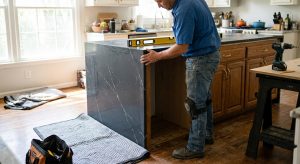
Deciding between countertop fabrication vs big box store installation is one of those choices that looks simple on the surface but carries real consequences for your finished kitchen or bathroom. The two paths diverge on nearly every dimension that matters: material quality, measurement precision, customization depth, and what happens after the installer leaves. Here is a clear-eyed breakdown of both options so you can make the call with confidence.
Quick Overview: Two Very Different Ways to Get a New Countertop
A 2023 National Association of Realtors study found that minor kitchen upgrades returned 67 cents on every dollar invested, while upscale kitchen remodels returned closer to 59 cents. The difference in return is not just budget size. It is quality execution. Countertop selection and installation quality are among the top three factors homeowners cite when they rate renovation satisfaction, according to Houzz’s 2023 U.S. Houzz Kitchen Trends Study of more than 2,600 respondents. Choosing the right installation channel is, in practical terms, choosing the outcome of your project.
What a Custom Fabricator Does
A local fabricator runs the entire process under one roof. The sequence looks like this: a templating technician visits your home to map every angle, cutout, and overhang with laser precision. You then visit the slab yard, or the fabricator brings samples, and you hand-select the exact piece of stone going into your space. From there, the slab is cut on CNC equipment using your digital template, edges are profiled to spec, and the same business that cut the stone sends its own crew to install it. One company. One point of accountability from start to finish.
What Big Box Installation Looks Like
The big box route starts in-store. You choose from a curated set of pre-packaged materials tied to installation pricing tiers. A separate measurement appointment is scheduled, handled by a subcontractor. That subcontractor’s specs go to a third-party fabrication facility. When fabrication is complete, a regional installation contractor is dispatched. By the time anyone touches your countertop, three or four separate companies have handled the project, and none of them have spoken directly to each other about your specific kitchen.
Material Selection and Slab Quality
The 2023 Houzz Kitchen Trends Study found that quartz and natural stone remain the top two countertop material choices among homeowners spending $25,000 or more on kitchen renovations. What that data doesn’t capture is how dramatically material quality varies within each category, depending on where and how you source it.
Fabricator Access to Full Slab Inventory
Local fabricators source directly from regional slab distributors, which means you walk through an actual yard and select the specific slab that will be cut for your countertop. This matters more than it sounds. Natural stone slabs from the same quarry batch can vary significantly in veining, coloration, and pattern density. When you pick the slab yourself, you eliminate the risk of receiving a material that looks nothing like the sample you approved in-store. For kitchens with islands or L-shapes requiring multiple slabs, a fabricator can also match veining direction across pieces, something a big box program’s pre-packaged model simply cannot accommodate.
Big Box Material Catalogs and SKU Limitations
Big box programs offer a finite catalog of materials, each tied to a pricing tier. The selection is curated for volume purchasing, not design range. If your kitchen has a distinctive tile backsplash or custom cabinetry that requires a specific stone movement or finish, the available SKUs are unlikely to satisfy that requirement. For homeowners renovating above the entry-level price point, this ceiling on material specificity is the first concrete limitation you will run into.
Measurement, Templating, and Fit Accuracy
According to a 2022 report from the National Kitchen and Bath Association, measurement and fit errors rank as the leading driver of countertop installation complaints, cited in 38% of unresolved disputes between homeowners and contractors. The way each channel handles templating is where that statistic becomes real.
Laser Templating by the Fabricator
A fabricator’s templating technician uses digital laser equipment to map your countertop space to within fractions of a millimeter. That digital file feeds directly into the CNC cutting machine. The person responsible for measuring and the business responsible for cutting are the same entity, which means there is no handoff where data gets misinterpreted, transcribed incorrectly, or simply lost. Sink cutouts, cooktop openings, wall irregularities, and out-of-square corners are all captured and addressed before a single cut is made.
Big Box Third-Party Measurement Appointments
In the big box model, a measurement subcontractor visits your home, takes dimensions, and forwards specs to a fabrication facility that has never seen your kitchen. If that template is even slightly off, the error compounds at every subsequent step: the fabricator cuts to the wrong dimension, the installer shows up with a slab that doesn’t seat properly, and the resolution process involves coordinating between parties who don’t share a direct reporting relationship. Homeowners in this situation often describe waiting weeks for a remake while their kitchen sits without a functional countertop. Understanding what a complete countertop installation actually involves before you sign anything helps you spot these gaps in coverage before they become your problem.
Customization: Edges, Cutouts, and Finishes
Custom Edge Profiles and Finish Options From a Fabricator
A full-service fabricator can execute virtually any edge profile you want: waterfall edges that continue down the cabinet side, ogee profiles with their classical S-curve, mitered edges that create a thicker slab appearance without the added weight, simple bevels, and everything in between. Finish options extend beyond standard polished surfaces to leathered textures, honed matte finishes, and brushed treatments that change how the stone reads in different lighting. For Charlotte homeowners matching countertops to existing architectural details, custom cabinetry, or high-end appliances, this range of execution is not a luxury. It is a requirement for a coherent finished room.
Standard Options Available Through Big Box Programs
Most big box installation programs offer three to five edge profiles: eased, beveled, bullnose, and sometimes ogee. Finish choices are typically limited to polished. These options are adequate for straightforward layouts in entry-level renovations. For anyone investing in a mid-to-upper kitchen remodel, the standard menu puts a hard ceiling on what the finished product can look like, regardless of what you’re paying for the material itself.
Installation Quality and Accountability
A 2021 consumer survey by Angi found that 43% of homeowners who used big box store home improvement services reported at least one issue requiring follow-up after project completion. Among those who used local specialty contractors for the same category of work, that figure dropped to 19%.
Fabricator-Employed Installers
When a fabricator employs its own installation crew, the same business that designed, templated, and cut your countertop is responsible for seating it correctly. If something is off, there is no second party to point at. The fabricator owns the outcome. That accountability structure changes quality standards in practice. Installers who work directly for a fabricator know that their work reflects on the company’s reputation with every single project, which is the kind of direct feedback loop that a subcontractor arrangement doesn’t create.
Big Box Subcontractor Assignments
Big box programs draw from regional labor pools to assign installation. The contractor who shows up may be highly competent, or not. You have no meaningful input into that assignment, and the store itself has limited leverage over a contractor’s on-site behavior once the job begins. When something goes wrong, the recourse path runs through the store’s customer service department, which then contacts the subcontractor, who may or may not respond quickly. If you are evaluating any countertop company’s track record before committing, the installer accountability model is one of the most telling things to look at.
Turnaround Time and Project Scheduling
The National Kitchen and Bath Association’s 2022 project timeline data shows that kitchen renovations involving countertop replacement average 3 to 6 weeks from contract signing to installation completion, with measurement errors and material reorders being the two primary causes of timeline extension.
Fabricator Scheduling and Lead Times
In the Charlotte market, a local fabricator typically runs a timeline of 1 to 2 weeks from template to installation for in-stock materials. Consultation and material selection happen before the template appointment, so that time runs in parallel with your broader renovation schedule. When your general contractor needs the countertop installed on a specific day because plumbers and electricians are sequenced around it, a local fabricator can accommodate that conversation directly. Scheduling flexibility is a real advantage when your project involves multiple trades.
Big Box Timeline From Measurement to Installation
The big box process involves sequential scheduling steps that don’t run in parallel: store visit, measurement appointment booking (typically 1 to 2 weeks out), measurement visit, order processing, fabrication lead time, and then installation dispatch. From first store visit to installed countertop, the realistic range is 4 to 8 weeks, with the most common delays occurring between the measurement appointment and order confirmation. For renovations with contractor-dependent scheduling, that unpredictability creates downstream problems across the entire project.
Pricing: What You Actually Pay
How Fabricators Price a Full Project
A local fabricator’s quote typically breaks out material cost per square foot, edge profile charges, cutout fees for sinks and cooktops, removal and disposal of existing countertops, and installation labor. These line items are visible, which means you can compare them directly. What you see in a fabricator quote is what the project costs. There are no add-ons that surface after your credit card is on file. When you’re going through the process of vetting a countertop installer, asking for a fully itemized quote is the simplest way to confirm you’re dealing with a transparent operation.
How Big Box Pricing Is Structured
Big box programs advertise a price-per-square-foot figure that covers material and basic installation. The charges that catch homeowners off guard include: upgraded edge profiles (sometimes $10 to $20 per linear foot above the base package), undermount sink cutouts, cooktop cutouts, removal and haul-away of existing countertops, and trip charges for return visits. By the time these line items are added, the final invoice frequently exceeds the original estimate by 20 to 35 percent. The advertised price is a floor, not a ceiling.
Warranty, After-Sale Support, and Long-Term Relationship
A 2022 J.D. Power Home Improvement Retailer Satisfaction Study found that post-installation service responsiveness was the single lowest-rated dimension across big box home improvement programs, with a satisfaction score 22 points below the industry average for specialty contractors. The reason is structural: a big box store’s primary business is retail, not service. After the installation is complete, your countertop is one of millions of transactions. A local fabricator’s business, by contrast, depends on referrals and repeat work from within a defined geographic market. A craftsman who has been working in Charlotte’s remodeling industry for over a decade has a direct stake in how your countertop holds up two years from now, because you and your neighbors are the market. That accountability doesn’t expire when the installation crew leaves your driveway.
When to Choose a Local Fabricator
Choose a local fabricator when your project involves custom cabinetry, irregular layouts, high-end materials, or any configuration that requires coordinated decision-making across the design and fabrication process. This includes full kitchen renovations, primary bathroom remodels, kitchen islands, and any project where the countertop is a visible design centerpiece rather than a utility surface. If you are investing $20,000 or more in a kitchen renovation, the countertop is not where to introduce a multiparty coordination chain. You want one business that can answer your questions, own the outcome, and stand behind the work after the fact. For Charlotte homeowners exploring what distinguishes a qualified local shop from a generalist contractor, fabrication experience and in-house installation are the two most concrete differentiators to verify.
When Big Box Installation Makes Sense
Big box installation is a reasonable fit for small, simple projects: a single vanity top in a guest bathroom, a rental property upgrade where budget is the primary constraint, or a straightforward rectangular kitchen layout with standard material choices and no design requirements beyond the basics. If you are replacing a countertop in a property you don’t intend to hold long-term, and the existing layout is simple and square, the cost efficiency of a big box program can make sense within those constraints. Just go in with clear expectations about timeline, add-on fees, and the fact that you will have limited recourse if the installation doesn’t meet your standard.
Verdict: Which Option Wins for Charlotte Homeowners
For most mid-to-upper renovation budgets in Charlotte, a local fabricator is the stronger choice. Full stop. The material access is better, the measurement process is more precise, the customization range is wider, and the accountability structure is cleaner. You get a single business responsible for every stage of the project, from the slab you select to the seam that gets finished against your backsplash.
The one scenario where the big box route remains viable is a simple, budget-driven replacement in a space that doesn’t require design precision. Rectangular layout, standard material, no custom edges, and a willingness to manage the coordination yourself if something goes sideways.
The concrete next step: get a line-item quote from a local Charlotte fabricator before you make any decisions. Compare it to what the big box program actually costs once you add edge profiles, cutouts, and tearout. In most cases, the gap is smaller than you expect, and the difference in outcome is significant.